Friday, February 24, 2017

"Stop Using Women And Girls To Justify Transphobia" - Huffington Post Still Thinks All Women Think The Same

A certain article that I saw from the Huffington Post has peaked my interest. Mostly, I'm fascinated by the truly sincere arrogance and sexism displayed by the writer, and before the reader judges this article solely off of this statement, I will explain further down in the article exactly what I mean.

First, I want to talk about the article itself. Alex Berg posted yesterday her trending article "Stop Using Women And Girls To Justify Transphobia," which has been shared many times over on Facebook and was featured as a 'trending' article on the Huffington Post website. Berg describes herself as a multimedia journalist since she helps produce many of the Huffington Post's video segments along with documentaries dealing with the troublestroubles faced by the transgender population, and she focuses mostly on LGBTQ issues in her reporting. 

The Voice of All Women
Her article is an opinion piece about the recent announcement from the Trump Administration where the president has stated that he will repeal a guidance put in by the Obama Administration allowing transgender people the ability to choose their bathroom of choice in a public school. Overall, she has reacted very negatively to the action, and she is very upset that those who opposed the guidance are using the protection of young girls as an argument against allowing transgender people into children's restrooms. 

After claiming that rescinding the access of transgender women to women's restrooms in public schools as discrimination against the LGBTQ community, Berg begins her argument as such:
"A common claim that opponents of such protections for trans students make is that allowing transgender people into bathrooms endangers cisgender women and girls. In his much discussed appearance on “Real Time,” alt-right former Breitbart editor Milo Yiannopoulos told host Bill Maher that he “makes no apologies for protecting women and children from men who are confused about their sexual identity.” This argument perpetuates the myth that trans people are predators, when they are far more likely to face violence and harassment in restrooms at the hands of cis people."

It looks like Berg really looked at the facts when she decided to write her piece. The only problem is that the articles she is linking to are either misquoted by Berg or useless in terms of factual evidence. The first article that references how some argue that allowing transgender persons into bathrooms endangers cisgender women is actually a link to an interview with self-proclaimed radical feminist and chair on the director's board of the Women's Liberation Front, Kara Dansky, on "Tucker Carlson Tonight." In Dansky's interview, she did not say that the Obama guidance was endangering cisgender women, and instead she talked about the difference between rights for biological women and transgender women. From the Fox Insider article that accompanies the video segment;
"'We think that 'women and girls' are a meaningful category worthy of civil rights protection,' she [Dansky] said. 'If we define sex, under Title IX, to mean gender identity, what we're essentially saying is that "women and girl" can mean anyone who self-identifies as "women and girl," which makes the category "women and girls" meaningless as a category.'"
Of course, it might be silly to assume that anyone can assume themselves as a different gender and therefore be legally defined as "transgender" under US Federal Law. Historically, the legal definition of transgender and gender identity has been left up to the states, but according to the original text from Obama's issued guidance, the letter ultimately usurps the state's power of transgender issues regarding public schools.

The guidance states that any individual who doesn't claim to be their biological gender may be allowed to classify themselves as whatever gender they please. It's also fairly important to note that the guidance doesn't say "student" in these definitions, and instead only says "individual." Although the definition is broad and vague, perhaps intentionally, the guidance does relate these definitions to Title IX as a student related issue. What's baffling is that there is no qualification for being considered transgender, including medical or legal.


Kara Dansky is right when she says that anyone who wants to claim that they are a woman or a girl will be treated as a woman or a girl. The Title IX amendment as given by the Obama Administration grants that power to any student of any school receiving federal funding, which includes all public education systems and any school that receives tuition from Pell grants, FASFA loans, or other federal student aid programs. In essence, anyone who claims to be a woman can enter the women's restrooms, join school-associated battered women's shelters, join women's sports teams, enter women's locker rooms, receive housing in women's-only housing sections, and et-cetera, and the same rule applies to any person claiming to be a man. What I personally find striking is that the Obama guidance claims that disallowing men who claim to be women from entering female-only areas or joining female-only clubs, teams, and housing situations would limit or deny the transgender person from an equal access to educational programs or activities.

There are no educational programs that bar women or men specifically from attendance (except for historically all male or all female institutes, for which the majority have rewritten their rules to accept transgender students), however one could argue that sports teams that have been segregated by sex do limit certain gender's abilities to partake in said sports. I would argue that sexually segregated sports teams are something to be cherished due to the biological differences of the genders. Scientists once thought that women would one day be able to compete with men in track, cross country, cycling, and swimming events if they as a gender were allowed the equal opportunity of proper training, strong coaching, and more experience in the sports, however there is now considerable research available that states that women are unable to fairly compete with men due to the manner in which testosterone affects the muscles' strength and endurance along with the hormone's affects on heart size, oxygen levels in the bloodstream, and body fat percentage. As an example of this phenomena, here is a survey of ten thousand runners' 5k times compared by age and sex from pace-calculator.com;


The Obama ordinance has the potential of limiting or denying a student's ability to partake in an institution's activity by allowing a transgender female who doesn't have to provide medical documentation or partake in a medical treatment program to join a female sports team which would bar female students that didn't make the cut competing against a biological man and affect the outcomes of future competitions, games, and meets in the female sports team's league, and all the while the biological man will have complete access to the restrooms and locker rooms that would otherwise be restricted to his biologically female teammates. To reiterate, the transgender female wouldn't even be required to make an attempt to look like a female, and before I get criticisms for stating that females have a certain "look," I would like the readers attempting to make this criticism imagine a six-foot-tall, two hundred and forty pound transgender woman with a buzz-cut and goatee showering in the women's track team's locker room. Of course one might argue that this incident never happens and that it never would happen, but the response to such a quip is that if it were to occur, it would be legally acceptable. The fact is that there is potential for a man masquerading as a transgender female to dominate a women's sports league or enter and abuse women in a women's locker room, and that takes away women's protections from both unfair sports competitions against biological men and the reality that any male predator could potentially enter a woman's locker room or restroom.

To bring this conversation back to the quote from her article, Berg then goes on to mention right-wing provocateur Milo Yiannopolous, who stated that he “makes no apologies for protecting women and children from men who are confused about their sexual identity.” She uses Yiannopolous's name as a hyperlink to an article that criticizes Bill Maher for "taking credit for the former Brietbart editor’s swift downfall." Now, a discussion on Yiannopolous's alleged defense of pedophilia is definitely worthy of discussion, however due to the lengthy subject matter that would need to be addressed I will follow in Berg's footsteps by skipping the article's content entirely and only focusing on the quote. Yiannopoulos's quote is similar to Danksy's, and the provocateur is stating that the cost of allowing transgender females into women's restrooms, locker rooms, and other female-only areas is the risk of sexual assault from a man masquerading as a transgender female and the overall degradation of the value of women's biology. Berg counters this statement by claiming that theses risks aren't as important as the risk of bullying and abuse of transgender people in the bathrooms congruent with their biological genders.

With this counterargument, Berg is assuming several things about the sexes. I hope that the reader remembers my claim of sexism at the beginning of this blog post, because this statement is abhorrently prejudiced to men, women, and transgender persons. To begin, the assumption that transgender women won't be bullied, harassed, or assaulted in a women's restroom or locker room implies that only men or those who identify as men are capable of these actions; furthermore, the assumption that transgender men won't be bullied, harassed, or assaulted in a men's restroom also implies that only women or those who identify as women are capable of these actions. In regards to transgender people, Berg is assuming that a transgender person wouldn't abuse his or her access to a public restroom and that transgender people can do no wrong when it comes to sexual assault. This of course is untrue, like for example the 2012 case of Jessica Hambrook (who's legal name is Christopher Hambrook) who had been living as a woman for three years and joined two women's shelters where she raped and sexually assaulted several women.

To further strengthen her argument, Berg used her statement about transgender people being more likely to face harassment and sexual abuse as a hyperlink to a UCLA study done by Dr. Jody L. Herman, PhD. The study concludes that transgender persons and those that do not conform to their biological gender are unsafe and under threat of abuse in restrooms that do not correlate with their biological gender, however the study finds itself under serious scrutiny due to a couple of blatant biases. The first bias is the sample size; the survey consists of 93 individuals who either work, live, go to school, or have spent time in Washington, DC. The second bias is the $50 lottery award to apply incentive for people to participate in the survey. The third and most damning bias that totally discredits the study is the method of data collection used by Dr. Herman;


With a cash incentive and an inability to prove one's nonconformity of their biological gender identity, the data collected excluding the unlisted amount of personal interviews and the six follow-up interviews is rendered unverifiable and useless. Dr. Herman states in her paper that the follow-up interviews were used to give more qualitative data for the study, but it is a logical fallacy to use six singular instances as a method of describing an entire group of people. I am not trying to argue that transgender women don't face harassment or physical assault in the women's restroom, but Berg's use of this study to prove her point is in my opinion extremely careless.

Berg continues her article by further attacking the protection of women and young girls through sex segregation;
"Yet, Yiannopoulos’s line is a common refrain that continues to be used by those who care little about real, not mythical, violence against women. When walking back LGBTQ protections or promoting so-called 'bathroom bills,' proponents of such legislation have said that allowing trans people to use the appropriate restroom means men can 'enter private areas that are reserved for women and girls,' and that businesses that allow trans people to use the appropriate restroom pose 'a danger to wives and daughters.'

But invoking women’s safety while ignoring real violence faced by women and girls on college campuses, on the street and within their own homes is nothing more than a veil for hate. This so-called protection is a justification for transphobia — and as cisgender women, we’re done being your excuse."
These two paragraphs are a shocking collection of blatant sexism, name calling, and projection. To begin, Berg states that those who oppose the sex segregation of gender-specific areas do not care about the violence that she considers real. After boldly making this claim, she then goes on to ignore the fact that the anti "bathroom bill" stance is founded upon the reality that there are people who have been abusing this type of anti-discriminatory legislation for years already; or in other words, she ignores real violence that happens to women. I'd like to allow the readers to imagine a scenario where a middle-aged man enters a women's locker room, exposes himself to a group of young girls, and faces no criminal charges for his actions. It sounds ridiculous that this could happen, but there are already numerous reported cases of peeping toms and sexual predators gaining access to women's locker rooms by sexually identifying as a woman. As an example, here is an incident where a man entered a women's changing room at a public pool and disrobed in front of a girl's swim team. He did this twice, and he wasn't prosecuted since he identified as a woman. Here is another case where a 45 year-old man is known to have spent his day lounging naked in a women's locker room that is frequented by girls as young as six years old. In this incident, the man was not only exonerated from any criminal charge, but he was also given continuous free access to the women's locker room due to his sexual identification.

Berg states that those who oppose this type of legislation due to women's safety ignore violence against women on college campuses, the streets, and women's homes. This is not only a baseless claim, but also an extreme example of a straw man argument. Berg follow's the modern progressive left's practice of demonizing any person that disagree with her, and this is important when considering the information that she has cited to back up her claims in relation to this part of her quote;
"...as cisgender women, we’re done being your excuse."
One might notice that I put the word "we're" in bold. Here is where the true sexism begins to peacock out of Berg's ideology behind transgender specific legislation and women's safety. She is claiming here that cisgender women are sick of being used as a reason to oppose these types of bills, but a lot of her information that she has supplied to claim that those who oppose "bathroom bills" came from cisgender female feminists. The truth of the matter is that not all cisgender women agree that transgender females should be allowed in women's private areas in a business or public structure, and even the first person she linked to, Kara Danksy, was a cisgender woman who explained the exact kind of behavior that Berg is displaying in her article. Danksy stated in her interview that the progressive left and the majority of the radical feminist organizations do not want a conversation about transgender access to sex segregated areas of privacy, and any person that dares to oppose the so-called "bathroom bills" will be labeled as transphobic or hateful. Perhaps Berg's quote implies that she believes all cisgender women think the same in regards to transgender bathroom legislation, or maybe Berg is suggesting that cisgender women who don't want transgender females in their restrooms and locker rooms have forfeited their right to identify as cisgender. Maybe there really is some kind of collective consciousness of cisgender women, and I am just not aware of it, and all of the cisgender women who oppose "bathroom bills" are just putting on a show. No matter how I try and interpret this statement, it only comes off as not only sexist but also as a blatant disregard for the potential endangerment of women's safety and privacy, and a purposeful ignorance of the previously reported occurrences of sexual harassment and violence towards women as a result of this type of legislation.

The illogical hate Berg has for women's safety advocates continues with more straw man arguments and deceiving statistics from overtly biased studies;
"There are no recorded cases of transgender people harming anyone in the bathroom. In fact, trans people are far more likely to encounter violence and harassment themselves. In 2016 alone, at least 27 transgender people were murdered, the majority being transgender women of color. A whopping 41 percent of transgender people will attempt suicide in their lifetimes, compared with just 4.6 percent of the general public, according to the American Foundation for Suicide Prevention and the Williams Institute. On top of that, trans women encounter structural sexism just as cis women do. Perpetuating the lie that transgender people are predators just feeds into this discrimination. And we cis women never asked for this kind of “protection” to begin with."
As I've demonstrated earlier, the statement of "no recorded cases of transgender people harming anyone in the bathroom" is a blatant lie. The lie comes from the fact that Berg is ignoring the definition of "transgender" and "gender identity" used in the Obama guidance. Any person who claims to be a transgender person is by the legal definition of the former Title IX guidance a transgender person regardless of medical diagnosis or attempt to display some sort of effort towards transitioning to the claimed gender identity. The 45 year-old man who flashed young girls in the Washington State public pool was protected by this type of legislation, since he is legally considered a transgender woman by definition. Jessica Hambrook who raped young women in the Toronto women's shelters was granted access to the shelters' sleeping quarters, restrooms, and locker rooms due to her legal status of being a transgender woman. The argument against the "bathroom bills" is not centered around those who are transgender and seeking out the proper medical help for their situation; it is about refusing to allow persons with malintent the legal ability to enter any female-only area of privacy while placing women and girls in unnecessary danger.

The rest of the paragraph enters transgender people into the Oppression Olympics, and Berg tries to convince her readers that the safety and privacy of female-only areas is irrelevant because of how badly transgender people get treated by society. These issues are very sad and disheartening, but they are all straw men; and furthermore, if I was a transgender person I would find it incredibly insulting that someone would try to state that sex integration for restrooms and other gender-specific areas of privacy would solve or combat the transgender suicide crisis. I would think that if 41% of all transgender people are attempting suicide, then there is a much more serious problem going on than feeling uncomfortable in a bathroom. The other argument that one could make is that transgender people are attempting suicide due to the amount of harassment they receive on a daily basis, but not only would granting bathroom access be irrelevant to solving this issue, the argument also frames a massive mental health issue that is plaguing the transgender community into something so trivializing as being harassed. There are (however unfortunate) a plethora of minority communities that are harassed on a daily basis, but the transgender community, according to Berg, are somehow the only community that is affected to the point in which there exists a 41% attempted suicide rate. There is no other community in the United States that comes withing spitting distance of 41%, and the margins are historically unheard of. To give some perspective, during the Holocaust, the rate of suicide in Nazi internment camps was somewhere between 25,000 to 100,000 suicides a year, meaning that 8% would be the highest possible estimate for risk or rate of suicide (the calculation being 500,000 divided by 6 million).

In my personal opinion, I think it is crazy to outright disregard the blatant safety risk imposed by allowing transgender person under the current legal definition to enter female-only and male-only areas. I think it's even crazier to make statements such as "Transgender people should be able to enter whatever bathroom they want because they try to kill themselves a lot" or "transgender people should be able to enter whatever bathroom they want because there's rape culture and people who don't support 'bathroom bills' don't care about rape culture;"
"If opponents of trans protections sincerely cared about the safety of women and girls, they’d care about ending rape culture. They’d care about holding President Trump accountable for more than 15 allegations of sexual assault and harassment against women. And they wouldn’t paternalistically tell us who we ought to fear when we proudly count trans and queer people as part of our communities."
Allowing predators a loophole to legally enter women's restrooms and locker rooms is rape culture. President Trump's sexual assault allegations are so amazingly irrelevant that I shouldn't have to mention that they've all either been heavily discredited or the alleged victim has made a point to disappear (possibly because some of them were paid actors). Just because someone is against the "bathroom bills" doesn't mean they are telling you to fear trans people. There is more than one way to skin a cat, and just because people are questioning a law's practicality, it doesn't mean that those people are evil or succumbing to some sort of 'phobia.'

The good news is that I don't have to let people make me feel bad about caring for women's safety in public restrooms, and I hope the readers who took the time to read my blog post understand that they don't have to feel bad either. If you know that what you stand for is right, then you don't have to let anybody tell you how to feel. Offense is never given, it's only taken. As soon as our society realizes this concept, we'll be much more productive when it comes to solving our societal issues.

 "[T]here is a very rich blogosphere and Twitter community of marginalized feminists, and I try to engage with that community, but I find that as a queer woman the way that I experience the challenges that feminism tries to address is really different from a the way a straight woman might experience feminism." I am marginalized because I am queer and that is unfair, but God forbid if you disagree with my political opinions then you are nothing but pure evil.


Thursday, February 23, 2017

"Real men provide/ Real women appreciate it," Triad Community Lets Seven Words Dictate Their Emotions/Actions, And KLEUR tries to Capitalize on the Situation

In the fourth week of February, crisis struck the state of North Carolina. Dozens of people are outraged enough to the point in which a statewide protest will be held at a small location on the business 40 interstate between Winston-Salem and Greensboro. The cause for the protest is this diabolical plot:

From the Triad City Beat
That's right; it's a billboard with a slightly provocative, seven-word message. According to Joel Sronce of the Triad City Beat, the sign that has caused such an outrage is owned by the Whiteheart Outdoor Advertising company. The Triad's community has reacted so far by giving their unofficial Facebook page a rating of one star.

although, there has only been one rating given, so far
Joel Sronce contacted President Bill Whiteheart of the Whiteheart Outdoor Advertising company for comment, to which he responded:
"We understand very well, I’m sure as you do, the Constitution of the United States, and it is a ‘freedom of speech’ type message where the parties that have paid for that advertising are conveying a heartfelt message to the public."
Of course one would be incredibly naive in believing Mr. Whiteheart's statement, since as Joel Sronce points out Mr. Whiteheart is a dirty republican.

does this ring a bell?

The protest is being hosted by KLEUR, a company that describes itself as a "Lifestyle Supply and Marketplace," and it functions similarly to any other middle class clothing store if the store had a coffee shop, a lounge, a donation page, and a social justice warrior attitude. Since this new era of protesting everything can cause misunderstandings as to why a certain company would endorse a political protest, I visited KLEUR's page on Facebook to try and find out what the protest is about. The page states a manifesto of action 
against the harmful sign:

"This billboard is new and currently standing on West Bound Business I-40, headed into Winston -Salem from Kernersville

On Sunday we have a public demonstration expressing our feelings about why this is offensive. If you are a woman or man who feels this is a harmful message, please consider joining us. Stay tuned for location and plan.
The power here is in numbers, so PLEASE make this a priority, and PLEASE spread word and request your friends join and show up. Don't abandon this! Show up right at 11 in case we are made to disperse. (We are looking into securing a an escort but that seems unlikely...so be it. ) 
Call the local papers and news network and demand they come and cover this. The more calls they get, the better." 
According to these statements, KLEUR wants a lot of people to attend, but more importantly they want a lot of press coverage for their event. Although I am now aware that the company is looking for that sweet, sweet free press, I'm still a little confused as to what the protest is about. I think some people often get confused when I ask these kinds of questions, but I am genuinely not sure what the sign is saying that should cause such an outrage, and in these kinds of situations I get frustrated with the lack of reasoning given by the protest coordinators. I understand that some might feel this is offensive, but since I don't exactly understand why I'm looking for the reasoning behind KLEUR's response. So far, I can only tell that the company is only looking for free advertising.

Luckily for me and for the others who may be confused, KLEUR posted an update on their page:
"*EDIT*
We are NOT protesting that the sign is capable of existing, or the people who put it up, or the ad agency, or the right to put it up. We are protesting patriarchy and sexism, and that this antiquated way of thinking about women exists at all. We are protesting the implied demand that women be silent and appreciate, regardless of whatever circumstances, their role as non-providers."
From here I can gather a few more pieces to the puzzle, but I'm still having trouble putting everything together. If we look at the definition of the word "protest," the word serves as a noun to signify a stance of opposition, and as a verb it either means to project that stance of opposition or to dispute the legality of a certain action. In this case, KLEUR has stated that it is not protesting the legality of the statement, but they are wishing to express their dissent of their interpretation of the seven deadly words on the sign. Essentially, what KLEUR is doing is gathering a large amount of people to sit near the sign for several hours and state that they don't like this thing.

In regards why KLEUR doesn't like the sign's message, I am still left a little puzzled. KLEUR is protesting patriarchy and sexism, and the implied demand that women be silent and appreciative as a non-provider.

So let's look at the sign's message, "Real men provide/ Real women appreciate it." Even though the statement is only seven words long, I think I'll need to break it down to fully analyze a fair interpretation.

"Real men provide." To provide is to make arrangements for supplying a means of support, be it money, love, affection, or even a literal, physical support of a person's body. The sign states that a real man would supply or prepare previous arrangements for the supply of some time of support. The opposite of this would be for the man to not supply anything at all. I think that it is fair to suppose that the sign is speaking in terms of a relationship or a marriage, and if that is the case, I don't know of a real man that wouldn't be supplying whatever support he could in a relationship. If I was a woman that was married to a man that wasn't supplying support of any kind, I would drop him so fast that he'd break the sound barrier.

"Real women appreciate it." If I  analyze this sentence in the context of the first statement, keeping in mind that the sign is referencing a relationship or marriage between a man or a woman, then the word "appreciate" means to recognize the full worth of something or to be thankful and express gratitude towards something. If a man is providing for his wife or partner, should the woman not have to be appreciative for it? If I were married to an unappreciative woman, I'd leave her faster than Britain left the EU.

KLEUR states that these phrases are sexist, so to explore this idea, I will manipulate the phrase and explore its opposites.

"Real men don't provide, Real women appreciate it." In this case, the sign would be stating that women appreciate it when their male partners don't provide for them or their family. I think it would be common sense to state that no woman would want to be in a relationship with a nonsupporting or uninvolved man, and furthermore no self-respecting person would appreciate being in a relationship with such a partner.

"Real men provide, Real women don't appreciate it." This statement would imply that if a woman wanted to consider herself "real," then she shouldn't appreciate it when her male partner provides for her or for her family. A sign with this message would be promoting an attitude of disdain towards husbands and their efforts to support a family in whatever way they can, and if that were the case I would argue the sign would be very sexist. Thankfully, this is not the sign, and women don't have to be unappreciative in order to be "real."

"Real men don't provide, real women don't appreciate it." To take the sign's message and change it to the exact opposite only reinforces the original message of the sign. I don't think either partner of a relationship would appreciate their better half being nonsupportive or unhelpful. A relationship is not a one sided deal; it's a team effort that requires two teammates. If one teammate isn't putting in his or her fair share, then that team is never going to make it to the playoffs.

Another way to analyze the statement for sexism would be to lengthen it's wording and over-complicate it. From this, I would say an accurate lengthening would be this; "Men of worth provide for their partners with their best efforts in either a relationship or marriage, as opposed to being nonsupportive or wholly uninvolved in the two's combined efforts. Women of worth appreciate their partners' provisions, as opposed to being unappreciative or ungrateful for their partners' support."

I could also reverse the roles of the genders in the statement and see how the message portrays itself in a different context; "Women of worth provide for their partners with their best efforts in either a relationship or marriage, as opposed to being nonsupportive or wholly uninvolved in the two's combined efforts. Men of worth appreciate their partners' provisions, as opposed to being unappreciative or ungrateful for their partners' support." As I stated earlier, a relationship is a team effort. Both parties are expected to provide something, and the situation is never as black and white as some might want to believe. If the man has job and the woman is a stay-at-home mother, then the man provides the money and the woman provides the childcare and other housework. If both the man and the woman have jobs, then they both provide money, childcare, and housework. If the woman has a job and the man is a stay-at-home father, then the woman provides the money and the man provides childcare and other housework. Of course, these aren't rules, however these are statements that anyone who has reasonable common sense and views a relationship or a marriage as a team effort would say. For example, just because one partner has a job while the other partner is unemployed doesn't mean that the job-bearing partner never has to watch the kids or clean the house or what have you, but if he or she is gone most of the week while the other is at home all day, maybe the stay-at-home parent should focus more on the housework. These situations are vastly unique across every individual relationship, and a healthy marriage comes with the discussion of how both partners can help contribute as opposed to deciding who is the provider and who is the non-provider.

The word "sexism" defines itself as prejudice or stereotyping against one gender, but it's hard to tell if any analysis I've come up with so far contains any form of prejudice towards either gender. The billboard isn't saying anything specific about either gender unless an onlooker perceives it in that way. I think the billboard can be interpreted in a hundred thousand different contexts if I really sat down and thought about it. Perhaps the billboard is stating that most men don't provide, or that most women don't appreciate their partners' provisions, or that men should always provide and women should always appreciate. In reality, if someone is trying to make a statement that is only seven words long, it probably isn't worth the time to come up with all of these possible interpretations.

In regards to KLEUR's assessment that the billboard promotes patriarchy, I just don't see how that can be the case. KLEUR is attempting some sort of virtue-signaling campaign to capture the attention of women who care about gender equality and manipulate it for publicity reasons. If the protest isn't meant to promote action to remove the billboard, surely KLEUR knows that a protest of this manner would only bring it more attention. Maybe KLEUR isn't aware of the free market of ideas and how attention is used as a currency to invest in arguments, and the lack of attention is the number one killer of stupid ideas, but since I don't doubt the intelligence of KLEUR's businesspeople, I'm sure they know exactly what they are doing. Broad claims such as "the billboard demands that women be silent and appreciative," are such large, vague stretches that it's almost criminal that they are able to get people to believe them.

The question still remains; what does the sign really imply in its statement? Well, according to Joel Sronce's interview with Bill Whiteheart, the party responsible for the sign's erection has stated that "they will have a forthcoming announcement in the future." Although I would say it would be much more responsible to wait and see what other shenanigans the billboard activist has planned, KLEUR has decided to go gung-ho into the "scream and yell at the things we don't like" phase in accordance to the new era's rules for civil discourse. Although I wholly believe that the protest will not accomplish anything, I am confident that the protesters will tell me that I'm wrong while finding the self-righteousness that they are searching for.

When I was growing up, I was taught that offense is never given, but only taken. I hope that those who are truly outraged by this sign can one day learn to look past such petty things and focus their passion on bigger and more important issues. Maybe the person who paid for the billboard only wanted to see a reaction from it, and we're all playing into his or her pocket.

Wednesday, February 22, 2017

Social Change is a Cult

I go to a small liberal arts college,and I'm only posting this because I hope people realize that liberalism shouldn't be laughed at and called a 'mental illness,' and instead it should be recognized as to what it truly is; a cult.

For one of my classes, I was required to attend a seminar given by Tony Woodcock, who is a leading pioneer in the field of arts management and music education. He was also the president of the New England Conservatory for a number of years, and he's established outreach programs for big-name orchestras that he's managed. He also apparently writes for Huffpo from time to time, as I just learned.

The thing about Tony Woodcock is that I know deep down in his heart, he is a good person, but he has been manipulated, and it was so obvious to me during his seminar. He gave a lecture about "our duty as artists to help change the world," and I wish I had recorded the lecture due to the outright brainwashing he tried to do to the students in attendance. His core message throughout the lecture was this, "if you have the time to be creative while another person in another part of the world is starving, have you really done your job as an artist?" Another strong theme was the purpose of charity, and he repeatedly made statements such as, "in the so-called 'developed west,' we combat poverty by paying for our avoidance of it through poverty," which of course leads me to believe that this guy doesn't give to charity and has found a way to not only justify his decision to not give to his fellow man but also a way of feeling superior about it.

Although, I can't say that he doesn't give to charity since he has helped develop several arts outreach programs in the US for underprivileged youth, however it's his reasoning behind it that seems incredibly strange. His goal was to get us, a handful of artists at a liberal arts conservatory, to enact what he calls "social change" in our communities, and he went on spiels about how it's our duty to help illegal immigrants and refugees and protect women's rights and promote racial equality and every other liberal talking point. At the end of the lecture, there was a Q&A portion, and I made the mistake of asking a simple question about his lecture. I said, "In regards to social change, what should we be trying to change into?" He asked me to clarify what I meant, and I said "What is the end goal to all of the social change?"

I didn't criticize him, I didn't speak out against his lecture, and I wasn't trying to be an edgy kid trying to attack some guy giving a lecture. All I wanted to know is what his goal for this social change was. After all, he explained to us that if we were not a part of the social change, then we would be bad people. I just wanted to know what social change I should push for if he wanted to consider me a good person. His answer to me was so crazy:

"I've never thought about it like that before. You know I think that young people and some older people get too caught up in this idea that there has to be an end goal, so I would say that it is more important to think about the change than to worry about what we should all be trying to accomplish."

What? You're going to tell me that I'm a bad person if I don't follow this ideology of social change, but you can't tell me why I should do it or what the outcome of it should be? Another lady that I didn't recognize chimed in saying that "It's specific to the community you're looking to work with, but I don't think we should be worried about an overall goal." I think that's an acceptable answer, but she was not the only one to answer a question that she wasn't expected to respond to. The dean of my school happened to be there as well, to which he said,

"I think your question is so important, but the end goal doesn't matter. What matters is how we can change people's lives through social change one step at a time."

Then, since this question was apparently open-ended and directed towards everyone, one of the other students in the audience responded, saying:

"I don't really think it should be about an end goal, but it is obvious that there is social change that needs to be done in the world. You might think that nothing needs to be done, but if you look at what's happening today and think that everything is ok, then you should probably do some serious self-reflection."

At this point my jimmies were properly rustled since I knew this student personally and I knew that he didn't involve himself with any charitable programs, and I'm not trying to brag about what I do but I spend a significant amount of time serving for a program (which I don't want to mention since it might cost me my position) where I go to underprivileged schools and help the teachers of those schools. I've helped illegal immigrants, I've helped refugees, and I've been to schools that were so bad that only 20% of the kids passed their reading and math EOG's. What's really crazy is that the question I asked suddenly took all of this information, and that student who said this to me knew this about me, and threw it out the window, even though my question wasn't critical or promotional. I was only asking for Tony Woodcock's reasoning, and he couldn't give it to me.

So let me get this straight; If I don't believe in this progressive ideology of social change, I am a bad person. If I even question the reasoning behind the social change, I am a bad person and it suddenly becomes ok to publicly ridicule me (I should note that I am paraphrasing, but the quotes are practically verbatim). Is this not a cult? Is this not an ideology of "don't ask why, just do as you're told?" I don't see my volunteer work (which is both a part of a certain program and outside of that program during my spare time) as social change or social entrepreneurship, I see it as me trying to be a contributing member of society. But that's not what they want, they want to see our society change, and you're either with them or against them. This is a cult.

Progressiveness, liberalism, social entrepreneurship; the left is a cult.


Here is an archive link to one of Tony Woodcock's Huffpo articles where he talks about Social Entrepreneurship and how there are corporate benefits to giving the poor a better education.

From the article:

"Their philosophies share commonalities too:
• They all hold up education as the foundation for improvement at the individual, family and societal levels, but they question very deeply the methods, relevance, and value of current systems of education." 
This means nothing. Nobody agrees with the current education system. These are just words.  
"• They value Social Justice and people above profits. For them, the notion that the poor represent the price of doing business is anathema. They understand that poverty is the result of choices and structures society has made." 
The poor don't represent the price of doing business. The poor represent the people that give up their rights to an oppressive government, or the people that have made life decisions in a non-oppressive government that have put them in their position. Tony Woodcock believes that people have no control over their own lives, and that a person's own choices don't affect one's own life. 
"• But most of all they believe that poverty is An Externally Imposed Phenomenon, which produces the misery and inequality that we see in the world today. They believe that the poor are fantastic human beings who represent some of the greatest potential for growth and human development. They are not the “deserving poor”; they are the poor who deserve our serious respect and attention."
Tony Woodcock believes that the poor cannot help themselves, and although he likes to say that the poor are fantastic and incredibly smart, he doesn't allow them the thought that they might be able to create success for themselves. They have to be helped because they cannot help themselves. They are the greatest potential for growth and human development, yet they can't do it on their own because society won't let them. 

It seems like such a thoughtful idea, but if I was on the receiving end of this philosophy, I would consider it incredibly insulting that these rich elite were looking to make a corporate gain off of my education because they believed that I couldn't help myself even if I wanted to. They believe that I have been wronged, and instead of allowing me to make my own choices about it, they will make those choices for me because I wouldn't be able to even if I worked my hardest to change my situation. This philosophy is so domineering and degrading at the same time; they claim that the poor aren't stupid or incapable, yet they don't trust that the poor can help themselves. 

Wednesday, January 25, 2017

A Response to the "Leftists and Conservatives have Different Brain Structures"

A Response to the "Leftists and Conservatives have Different Brain Structures" 


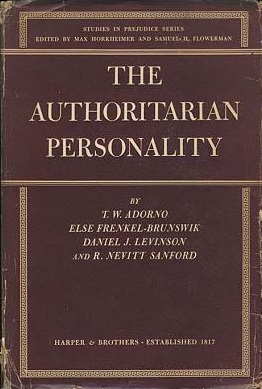
I would like to say that the idea where people with different political affiliations have different chemical and physical brain structures is new, but unfortunately this idea has been pushed since the late and post-World War II era. The Authoritarian Personality was written in 1950 by a group of sociologists from the University of California at Berkeley. Theodor W. Adorno, Else Frenkel-Brunswick,  Daniel Levinson, and Nevitt Sanford were all psychologists at the university, and together they performed a series of sociological studies that were aimed to identify what characteristics or environmental factors cause an individual to follow authoritarian or fascist ideologies. 

"The research to be reported in this volume was guided by the following major hypothesis: that the political, economic, and social convictions of an individual often form a broad and coherent pattern, as if bound together by a "mentality" or "spirit," and that this pattern is an expression of deep-lying trends in his personality. 
"The major concern was with the potentially fascistic individual, one whose structure is such as to render him particularly susceptible to anti-democratic propaganda. We say 'potential' because we have not studied individuals who were avowedly fascistic or who belonged to known fascist organizations."
The idea is that if one can identify social factors that have potential to cause an attraction to fascist or anti-semitic sociopolitical ideologies, then a global treatment could be procured so that one would be able to prevent future cases of fascist or authoritarian regimes taking control of a nation's political system. The studies were done primarily using questionnaires from different institutions in California, although the majority of the data collected came from college campuses, trade unions, military servicemen, and prisons from the surrounding area near UC Berkeley.

"In order to study potentially antidemocratic individuals it was necessary first to identify them. Hence a start was made by constructing a questionnaire and having it filled out anonymously by a large group of people. This questionnaire contained, in addition to numerous questions of fact about the subject's past and present life, a variety of antidemocratic statements with which the subjects were invited to agree or disagree. A number of individuals who showed the greatest amount of agreement with these statements—and, by way of contrast, some who showed the most disagreement or, in some instances, were most neutral—were then studied by means of interviews and other clinical techniques. On the basis of these individual studies the questionnaire was revised, and the whole procedure repeated."
Now, anyone who is knowledgeable of the scientific method should immediately become skeptical of these studies. When it comes to experimentation, first a hypothesis is formed, and then the experimenter looks for variables that can be manipulated to create consistent results. In the case of The Authoritarian Personality, these variables don't exist. To assume that one can find variables that can be manipulated to create an individual with strong authoritarian or fascist beliefs means that the researchers believe that there is a control factor when it comes to a person's social and political ideologies; therefore, the study itself has determined certain beliefs which are pathological and certain beliefs that are non-pathological. This implication of a pathological belief creates implicit political bias, especially when considering the inherent sampling bias for which the studies have been criticized heavily. For example, the writers of The Authoritarian Personality identified democratic beliefs with Marxist beliefs. For authoritarianism, the researchers used an odd mix of different ideologies.

"Opinion-attitude scales were used from the start in order to obtain quantitative estimates of certain surface ideological trends: anti-Semitism, ethnocentrism, politico-economic conservatism. Later, a scale was developed for the measurement of antidemocratic tendencies in the personality itself."
Antisemitism is obviously a factor that could be attributed to a fascist regime, but historically it has not always been the case. For example, Adolf Hitler was clearly an antisemitic leader, but Mao Zedong's cultural uprising in China had little to do with antisemitism; Mao an adamant believer in racial equality, and he even wrote articles that supported anti-discrimination laws in the United States. This however does not subtract from the fact that Mao Zedong's communist regime was one of the most deadly in history, killing more than Adolf Hitler and Josef Stalin combined.

Ethnocentrism is the judgement of a culture based off of an individual's own preconceived culture. Although this ideology often leads to racist tendencies, the use of ethnocentrism as a faucet of fascism is to say that the idea for me, an American College student, to say that the heavy presence of female genital mutilation in Somalia is morally wrong would be implicitly fascist or culturally insensitive by this definition. Perhaps the reason that ethnocentrism was used for the study's definition of fascism was due to the rise of nationalism in Germany while Hitler was taking power. Nationalism by definition is to have pride in one's nation, and many believe that pride in one's nation requires that their nation's culture must be compared to the cultures of other nations. This of course is a ridiculous assumption since pride doesn't have to do with comparisons, and a nation is not the same as a nation's government. For example, if a man is proud of his 1994 Ford Taurus, that does not mean that he believes his car is better than all other cars; his pride solely means that he feels a deep satisfaction of the quality of his vehicle. As another example, someone from the US can love his country and its beauty and culture, but he can also despise the grand canyon since its nothing more than a bunch of big holes in the ground. This man is still feeling a sense of pride in his country, which is in essence nationalism.

For politico-conservatism, it depends on which definition the writers were using. Over the years the definition of "conservatism" and what it means in regards to political theory has changed. The term was first used in France in 1818 to describe French politicians who wished to return to the governmental system from before the French Revolution. After Napoleon Bonaparte's dictatorship fell in Paris in 1814, a period of national rebuilding occurred called the Bourbon Restoration. During this time, many French politicians wished to return to the constitutional monarchy that had existed before the French Revolution and Napoleon's rise to power. This period of course was halted by Napoleon's return in 1815. So, to bring that to the modern day context, conservatism is a wish to return to older forms of governments, or in essence to return to "the way things were." For The Authoritarian Personality, the use of conservatism to describe authoritarianism doesn't exactly make sense; to explain, one must look at the history of the United States before the study had taken place.

1950 was an interesting time for the United States, since the nation had just entered the post-WWII era, Franklin D. Roosevelt had issued in his "new deal," and the African-American Civil Rights movement had entered its genesis with national demonstrations being held in the 1930's and 1940's as a reaction to several democratic policies, including Woodrow Wilson's laws that induced racial discrimination of federal hiring and segregation of the military in 1913. During this time, conservatism held a wide variety of views, but to get a general view of the political ideology in the US, one can turn to Russell Kirk's The Conservative Mind: From Burke to Elliot which was published in 1953. Kirk's book goes into great detail of the different types of conservative political beliefs that were practiced throughout American history, going all the way back to the American Revolution. In the first chapter, he lays out six characteristics that would later govern the evolution of conservatism into modern day politics. Those characteristics are as such:

  1. Belief in some form of higher power that governs morality in society and people. In the world, there is truth and what is right, and there is falsehood and what is wrong. There is an unchanging standard of morality in society.
  2. Affection for the variety and mystery of human existence. This is in contrast with "radical" views of the time which promoted egalitarianism and uniformity amongst the people. An example of this would be multiculturalism which pushes to meld different cultures under one identity instead of allowing multiple distinct cultures to retain their distinct identities. 
  3. Convictions in a rule of law and a middle class, as opposed to a middle class society. The conservative's definition of equality would be a meritocracy: all men deserve an equal opportunity at success, but this does not mean all men are guaranteed equal outcome from their efforts since not every man will give an equal effort in his respective opportunity. This way of thought promotes individual freedom, and its origin can be attributed to classical liberalism. 
  4. Freedom and property are linked, and without private property the state is unstoppable. The redistribution of wealth through taxes and nationalization of private corporations provides the government with complete control over its citizens, meaning that human rights can be stripped away. As an example, if the state nationalized news media as a way to provide equal pay for reporters, then the right to freedom of press will be taken away by policies of these government news media organizations. 
  5. Distrust in those who wish to radically rebuild governmental and societal systems with abstract designs. The conservative believes that some things are the way they are for good reason. These customary traditions provide a check on both anarchy and man's lust for power. 
  6. Recognition that change may not always be the best option. Potential change should be carefully investigated and debated before its implementation. Hasty political progressions have as much power to destroy as they do to improve, and therefore new policies or ways of government should be thoroughly analyzed in a public forum. 
The American politico-conservative view focused on limiting government power and protecting human rights. This is in sharp contrast of the fascist ideology which promotes authoritarian regimes as opposed to democratic processes derived from the Founding Father's classically liberal beliefs that hold great significance in conservative views. One could argue that since some of the researchers that contributed to The Authoritarian Personality are using the definition that would better suit post-WWI Germany when many wished to return to a constitutional monarchy, but if this were the case then the methods outlined by the book would be ineffective in analyzing many different conservative outlooks throughout the western world. Even if the methods were considered sound, which I will discuss soon why they are not, then they would only be usable for the analysis of the various political parties that formed during the post-WWI reconstruction period and the establishment of the Weimar Republic. In contrast to the post-WWI German conservative ideology, the beliefs as described by Kirk are a reaction to the Democratic party's cultural shift from classical liberalism to more socialist and Marxist ideologies, such as the redistribution of wealth by government mandate. 

After identifying the beliefs used by the researchers of The Authoritarian Personality to describe authoritarianism, one must wonder why these ideologies were used to identify individuals who were subject to anti-democratic propaganda. The use of antisemitism is obvious when considering two of the authors' histories; Adorno was a German composer and philosopher that was living in the United States in exile, and the US's conservative anti-Nazism and anti-communist positions placed immigrants like Adorno in a class of regulating policies for "enemy aliens." Frenkel-Brunswick was a Polish woman who fled to Austrian and then later to the United States during the Nazi's anti-Jewish persecution. Frenkel-Brunswick, Levinson, and Sanford were also all researchers of ethnocentrism, and they argued that ethnocentrism in a general sense can lead to antisemitism, which in turn caused the rise of Nazism in Germany. This argument ignores the history of post-WWI Germany and the 1918 German Revolution. One of the forces during this civil war was the Social Democratic Party of Germany which was led by a group of Jewish politicians that held strong Marxist and communist views. The SPD's revolution sparked an international conspiracy theory that the Bolshevik Revolution was also started by a secret group of Jews that were determined to take over the world through a communist uprising. It was easy for the German people, who were convinced that the Jews had created the USSR and led the German people into WWI, to blame the Jewish people for the economic struggles through harsh reparation payments and a loss of national pride. The rise of antisemitic ideologies in Germany was a response to the SPD's efforts and the Jewish conspiracy, and after the revolution there were already multiple antisemitic and fascist parties campaigning for dominance in the Weimar Republic. 

Another explanation of The Authoritarian Personality's political bias can be explained by the nature in which the research was funded. The authors of the book were working together with a group known as the "Frankfurt School of Critical Theory," which was a collective of German researchers that had fled Europe during WWII. Many in the Frankfurt School were Jewish Germans who previously conducted research at the Institute for Social Research, a predominantly Marxist school of philosophy that was terminated after Hitler's rise to power. The book was funded by the American Jewish Committee's Department of Scientific Research as a book series called "Studies in Prejudice." These were communist philosophers applying Marxist theories to psychology in order to explain how Germany could have allowed a man like Hitler to rise to power. 

In today's scientific community, the book is heavily criticized for its sampling bias, inherent political bias, and its pseudo-scientific attempt to link mental pathological symptoms with the "right wing." Sadly, as an unexpected product of the United State's national shock of the Holocaust as uncovered by the Nuremberg TrialsThe Authoritarian Personality began to shape the next two years of psychological research, and a psychologist's ability to link certain political beliefs with pathology became considered acceptable to a scientific community.  There are dozens of "scholarly articles" that go out of their way to link both conservative and liberal ideologies to various mental illnesses, yet all of them are unsound in their findings by the definition of the scientific method (which is a common trait in psychological research). 

The Authoritarian Personality is nothing but an analysis of different surveys and questionnaires. The problem with this kind of research is that there is no control, no accountability for different variables, and no ability to construct an experiment that would produce similar results. Surveys should never be used as scientific fact, since the only thing that a survey can provide for scientists is that there may be a correlation between two variables. Correlation does not mean causation. Correlation can be affected by virtually an unlimited different factors, whereas causation must provide a testable reason as to why an experiment under similar conditions will produce similar results. As an example, if there was a survey that sampled 20,000 Alaskans asking what they thought the weather was like today, the survey would not be able to prove that 99% of Americans think its too cold outside. 

If one were to account for other philosophies that came from the Frankfurt School, another incentive for writing a book such as The Authoritarian Personality arises that is far more sinister than just an innocent explanation of fascism in Nazi Germany. Herbert Marcuse was another philosopher who fled Europe during WWII and joined the Frankfurt School. In his infamous essay "Repressive Tolerance," which was released in collaboration with Robert Paul Wolff and Barrington Moor, Jr. in a collection titled A Critique of Pure Tolerance, Marcuse argued that it is morally just to eradicate opposing opinions by force. 
"Tolerance is extended to policies, conditions, and modes of behavior which should not be tolerated because they are impeding, if not destroying, the chances of creating an existence without fear and misery."
This way of though directly contradicts the theory of the free market of ideas, a philosophy that inspired classical liberals to classify the freedom of speech and expression as a fundamental human right. This belief of "intolerant tolerance" was a dominating belief throughout the Frankfurt school, and The Authoritarian Personality was written as a way to seek out individuals that could potentially think in the wrong way. To quote the book again:
"Opinions, attitudes, and values, as we conceive of them, are expressed more or less openly in words. Psychologically they are "on the surface." It must be recognized, however, that when it comes to such affect-laden questions as those concerning minority groups and current political issues, the degree of openness with which a person speaks will depend upon the situation in which he finds himself. There may be a discrepancy between what he says on a particular occasion and what he "really thinks." Let us say that what he really thinks he can express in confidential discussion with his intimates. This much, which is still relatively superficial psychologically, may still be observed directly by the psychologist if he uses appropriate techniques— and this we have attempted to do.
It is to be recognized, however, that the individual may have "secret" thoughts which he will under no circumstances reveal to anyone else if he can help it; he may have thoughts which he cannot admit to himself, and he may have thoughts which he does not express because they are so vague and ill-formed that he cannot put them into words. To gain access to these deeper trends is particularly important, for precisely here may lie the individual's potential for democratic or antidemocratic thought and action in crucial situations."
The Authoritarian Personality sought to classify not only political beliefs as formations from certain pathological factors, but also to create a way to identify and prevent potential political beliefs under the guise that these pathological factors are clear indicators of a fascist individual or a fascist individual in development.

A more modern example is to state that someone who is against gay marriage most likely suppressing his own homosexuality in fear of his father figure's infantilization and castration. Since the modern liberal considers an opposition to gay marriage as an opposition of human rights, those who are opposed to gay marriage are fascist by nature, and the cause of this fascism is a suppression of homosexual desires. This clearly cannot be the case since there have been a numerous amount of homosexuals that have infamously been against gay marriage, thus rendering the argument mute. In The Authoritarian Personality, the researchers do actually attribute suppressed homosexuality and a fear of castration from an individual's father figure as a key factor in determining the potentiality of one's fascist ideological development.

One quick note: I whole-heartedly support gay marriage, but I won't deny that there are arguments against gay marriage that are not homophobic. For example, there is a classically liberal stance which argues that there shouldn't be government involvement in marriage at all; furthermore, if the government's regulation of marriage expanded to the homosexual community, it would only allow the government's power over love to grow as opposed to fighting for no government involvement in marriage whatsoever. The Authoritarian Government would still classify this stance as homophobic even though it has little to do with a fear of homosexuals; the stance is more centered around the fear of the inherently evil government. 

So what about Gail Saltz?


"So I think what’s really fascinating is that there have been a number of recent studies looking at brain structural differences between liberals and conservatives. And what’s been found in several studies is that liberals tend to have a larger anterior cingulate gyrus. That is an area that is responsible for taking in new information and that impact of the new information on decision making or choices. Conservatives tended on the whole to have a larger right amygdala. Amygdala being a deeper brain structure that processes more emotional information - specifically fear based information. So it’s really responsible for the flight or fright response." 
To begin to deconstruct Gail Saltz' explanation of the physical differences between the Liberal and Conservative brain, there needs to be a little discussion about this quote. Gail Saltz is falsely assuming that a single part of the brain has only one singular job. The cingulate gyrus has many different jobs, including:
"An important part of the limbic system, the cingulate gyrus helps regulate emotions and pain. The cingulate gyrus is thought to directly drive the body's conscious response to unpleasant experiences. In addition, it is involved in fear and the prediction (and avoidance) of negative consequences and can help orient the body away from negative stimuli. Learning to avoid negative consequences is an important feature of memory."
"The anterior cingulate cortex presumptively regulates blood pressure reactions to behavioral stressors."
For the right hemisphere of the amygdala, it not only processes negative emotions, but it also plays a major role in memory:

"The right hemisphere [of the amygdala] is also linked to declarative memory, which consists of facts and information from previously experienced events and must be consciously recalled. It also plays a significant role in the retention of episodic memory. Episodic memory consists of the autobiographical aspects of memory, permitting you to recall your personal emotional and sensory experience of an event. This type of memory does not require conscious recall. The right amygdala plays a role in the association of time and places with emotional properties."
To further discredit Saltz' claim, the idea that right wing and left wing political beliefs are caused by physical differences in brain structure would require her to know two crucial things: there are only two political ideologies in the world that people associate themselves with, and that neuro-scientists actually know enough about the mechanics of the different areas of the brain to the point where they are able to find causation of certain beliefs and thought-processes. Of course, neither of these things are the case. In reality, across the globe there are vastly different political ideologies, including inside the United States. Its also important to note that neuroscience is a relatively new science, and so far there has been very little discovered when it comes to the brains mechanics. 

To go into further detail about the data from Saltz' claims, the study consisted of 82 test subjects undergoing a BOLD-fMRI scan while playing a gambling game that the researchers call "Risky-Gains." Of the 82 selected for testing, 60 were Democrats having an average of 22 years in age, and 22 were Republican having an average of 28 years in age. Women were over-represented by 57.32%, and Democrats were over-represented by 73.17%. In terms of determining ideology, the test subjects were linked to their publicly available voter histories. 

This study doesn't have a large enough or diverse enough sample size to be able to accurately depict future results using similar conditions. It downplays the roles of different factors that could have interfered with a subject's voting pattern; as an example, someone who is twenty-eight years old may have single issues related to their workplace or their specific assets, whereas someone who is twenty-two years old may either still be in college or university or may be dealing with a various number of issues that solely relate to the younger, non-college educated generation of the United States. The study is also based around the concept of risk-taking in an individual, so to say that a Liberal is more likely to accept new information and make decisions based off of said information because he is likely to have a anterior cingulate gyrus (the part of the brain that scientists believe controls the mind's processing of emotions, negative emotions and experiences such as fear, predictions based off of fear and negative emotions, blood pressure, and other possible unknown behavioral processes) because a majority of 60 liberals tested to have this trait is a very, very far reach. 

To conclude, neuro-political science and neuropolitics are pseudosciences at their very best. 

So what about Johnathan Haidt?


I may or may not go into further detail about Johnathan Haidt's TED Talk in a later post, but ultimately the post will be investigating his argument in two areas: what does he personally view as a conservative belief system and a liberal belief system, and is it really plausible to divide every person in the world into two different categories? Honestly, this way of political discussion does nothing but divide people by driving this concept that its always "left versus right" and there's no other way to view the world. This way of thought ignores an infinite number of political affiliations that don't align with modern liberalism and modern conservatism, while also leaving out the individuals that may switch based off of personal factors. 

What is the deal about these pseudoscientific "intellectuals" trying to push this false idea that when people disagree, its caused by a physical difference in their brain structure or by an environmental upbringing? Well, as I pointed out with the Frankfurt School and The Authoritarian Personality, these studies that try to pin political beliefs on physical construction or traumatizing personal events are always going to be factually unsound. The only purpose for this kind of discussion is to push an idea that American Citizens are divided not only by political ideology, but now by physical structure and social upbringing. 


Saturday, January 21, 2017

A Clarification of Personal Beliefs

A Clarification of Personal Beliefs

I've been asked by a friend of mine to clarify some of my views of the world. After a lengthy discussion of the government, he approached me with a synopsis of how he sees my worldviews, and since his synopsis is common in those that believe in the benefits of bigger government I thought I'd respond. 

He has attacked me from five different angles, and to quote him directly his statements were;

  1. You believe money is the highest form of motivation. 
  2. You believe money determines passion and the pursuit of talent/happiness. 
  3. You have a significant mistrust of the government.
  4. You feel the government is best utilized as a militarized/police entity. 
  5. Your version of a non-evil government is one in which the military and police protect those who have from those who don't, especially in cases where access to education, healthcare, and food and water are concerned. 
In these five attacks I can already sense the Marxism and the feeling of class warfare, along with the classic bullying attacks used by those who prescribe to cultural Marxist ideologies. The first attack from those who oppose the free market and the free market of ideas is always as such; "you only care about money and don't care about the less fortunate." Of course, this is a logical fallacy since at its core it is nothing more than an ad hominem attack. I do have to give credit to my friend's points, as they only vaguely allude to the typical response; he is more concerned with how much I value money, and my fear of the government and its ability to provide for citizens through social programs. Regardless, the desire for a government controlled market is clearly underlined in these arguments.

I'm going to go through each point one-by-one and try to clarify to my beliefs to my best ability. 

1. You believe money is the highest form of motivation.

The full quote for my friends first point;

"You believe money is the highest form of motivation. You also believe that a single-payer system implies equal pay regardless of job title."

To put this in context, he and I were discussing the role of the government and its involvement in the healthcare industry. His argument is a rebuttal to my argument;

"Higher profits lead to more jobs, better products, and better salaries. Lower profits lead to less jobs, worse products, and less salaries. Although we like to think that doctors do what they do out of the good of their heart, we can't deny the fact that there would be less neurosurgeons if they were paid the same as nurses."

As a quick note: I hate when people quote themselves, so I want to state I'm only doing this to help contextualize the discussion.

I think there may be a misunderstanding from my initial response. When I said that there would be less neurosurgeons if they were paid the same as nurses, I didn't intend to suggest that a single-payer healthcare system would pay healthcare employees a constant salary. My intention was to state that if there was a true single-payer healthcare system applied to the US's current healthcare system, the salaries of neurosurgeons would fall way below market value. If the salary for neurosurgeons falls below market value, then there would be less people interested in undergoing the lengthy, challenging, and incredibly expensive process of becoming a neurosurgeon.

Different careers require different levels of investment. The most common investment is the college degree or university education. If a person spends money on a college degree, they expect to be able to get a job that pays enough so that the person can get at least an equal return of investment for their degree.

I'm going to create a hypothetical scenario to explain how jobs are valued in the market. I'll periodically link to the sources used for data collection, and to calculators I used for estimated expenses.

Jane is an 18-year-old girl from Winston-Salem, North Carolina, and is interested in a career in plumbulignartistry. It's her absolute passion in life, and she can't imagine herself doing anything else. She wants to attend a local private school because plumbulignology (like neurosurgery) is a specialized field of study with few renowned university programs teaching such courses, and the school conveniently has a great program in plumbulignology. Her parents make a modest living, with both family members working as elementary school teachers with $44,015 annual salaries (the average salary for a teacher in Winston-Salem is $53,794).

Jane will really need to do some deep thinking in order to decide whether or not she should take this plunge into becoming a plumbulignartist.  First, how much does her university cost? In the 2016-2017 school year, private schools charged an average of $33,480 for both tuition and school fees, so let's assume that Jane's tuition and school fees will cost a total of $133,920 for her four years of schooling. In order to be able to do such a thing, Jane will have to apply for federal student loans.

Jane goes to a FAFSA calculator to get a proper estimate of how much she will receive in federal subsidized loans.
Parent wages: Each parent makes $44,015 ($88,030 in total)
Cost of attendance (including fees): $33,480
FAFSA Expected Family Contribution: $20,758
Expected Financial Need: $12,722 a year
As once can see, FAFSA will only grant Jane with $12,722, since the government assumes that Jane's parents will be able to afford $20,758.  Sadly for Jane, the government often overestimate the Expected Family Contribution for middle class families. After tax, her parents only make $72,859.48. If we factor in health insurance ($1117.53), car insurance ($2060 for two cars), mortgage ($860), and other expenses, that number quickly falls. According to Career Trends, the cost of living for a family of three in Winston-Salem is $55,217. So, in total, Jane's parents have an extra $17,642.48 to spare on Jane's schooling.
So, since the government expects Jane's parents to pay for $20,758 of Jane's yearly tuition and fees, Jane will have to begin looking elsewhere for loans. Next, Jane calculates in how much she will receive in Federal Direct Unsubsidized loans (here we will assume that Jane will receive the maximum amounts for the sake of the hypothetical, and as a better illustration for children of middle class families). Let's do a little math and see how much debt Jane will have after graduation.

Federal Direct Subsidized Total: 
$12,722 = FFDSL (F = Freshman Year Accumulation)
$25,444 = SFDSL (S = Sophomore Year Accumulation)
$38,166 = JFDSL (J = Junior Year Accumulation)
$50,888 = GFDSL (G = Graduating Year Accumulation) 
Federal Direct Unsubsidized total:  
.0376 = b (fixed annual interest rate)
.01068 = a (for the FDUL origination fee deducted from gross amount loaned)
5,500 - 5,500a  = FFDUL
(6,500 + (F+bF)) - (6,500 + (F+bF))a = SFDUL
(7,500 + (S + bS)) - (7,500 + (S + bS))a = JFDUL
(7,500 + (J+bJ)) - (7,500 + (J + bJ))a = GFDUL
FFDUL = $5,441.26
SFDUL = $11,941.81
JFDUL = $19,678.39
GFDUL = $27,620.13 
GFDSL + GFDUL = $78,508.13

Jane has a pretty nice chunk of money set up for herself here, but she's still a little shy of the $133,920 total that she needs in order to follow her dream of becoming the greatest plumbulignartist in modern history.  Luckily for her, the school she is applying to offers a Perkins loan! Now we'll add this loan to the mix (Perkins loans are only offered to students with extreme financial need, but to understand the overall investment of a college education in terms of student loans, I've added it as one of Jane's financial resources):

Perkins Loan Total:

$5,500 = FPL
$11,000 = SPL
$16,500 = JPL
$22,000 = GPL
GFDSL + GFDUL + PL =  $100,508.13

Things are looking great for Jane, but she still needs an extra $33,411.87 to afford her degree in plumbulingnartistry. Her luck hasn't run out yet, since the school she is applying to has offered to pay the rest of the tuition in scholarship as recognition for her excellent 3.7 high school academic GPA.

Jane is so close to making her decision, but there are a couple more things she needs to investigate before she decides to cave to her desires of studying plumbulignology and plumbulignocaphry. She continues her research by calculating a good estimate of how long it will take her to pay off her loans and how much per month she'll have to pay (I used a 20 year plan, since it takes an average of 21 years for students to pay off student loan debt for a bachelor's degree, but federal student loans are forgiven after 20 years):

Payment = Initial loan[(rate/12)((1 + rate/12)^month)]/[(1 + rate/12)^month - 1]20 year repayment planFLR (federal loan rate) = .0376PLR(Perkins loan rate) = .05m (months) = 240MP stands for Monthly Payment
FDULMP = GFDUL[(FLR/12)((1 + FLR/12)^m)]/[(1 + (FLR/12))^m - 1]
FDULMP = $163.90 per month for 20 years 
FDSLMP = GFDSL[(FLR/12)((1 + FLR/12)^m)]/[(1 + (FLR/12))^m - 1]
FDSLMP = $307.98 per month for 20 years 
PLMP = GPL[(PLR/12)((1 + PLR/12)^m)]/[(1 + (PLR/12))^m - 1]
PLMP = $145.19 per month for 20 years 
FDULMP + FDSLMP + PLMP = $617.07 per month for 20 years
$7,404 in repayments made per year
$148,096.80 in total repayments

Jane sees the number and her eyes widen. It costs a lot more to become a college educated plumbulignartist than she initially thought. She tells herself that the risk is worth the reward. She begins to estimate a salary needed to be able to pay off the loans after she graduates, especially since she'll only have nine months until her payments begin. In order to do so, she adds together her loans with the cost of living for a single adult with no children in Winston-Salem:

Annual Debt Collection = $7,404
Annual Cost of Living for Winston-Salem, North Carolina, as calculated for a single adult with no children = $29,144
$7,404 + $29,144 =  $36,548 

So this figure, $36,548, what does it mean? It means that if Jane wants the added value of a plumbulignartist's degree to at least cover the initial investment of her $148,096.80 worth of student debt, she needs to find a career that pays at least $36,548 a year. The student loans are Jane's initial investment and her cost of production, and her salary will be her marginal returns.


At this point Jane realizes that her choice is entirely dependent on what the average salary for a plumbulignartist is. As soon as she figures out what she could reasonable expect as payment for her specialized, college-educated skill, she can be confident in her choice to invest so much time and money into this career field. Jane rushes to her computer and quickly tacks away at her keyboard until she's left waiting for Google to giver her search results for the query "average plumbulignartist salary." To her dismay, Jane finds out that plumbulignartists don't make much, and in fact "plumbolignartist" is a word I made up to represent a low-paying career that requires an expensive college education (plumbum ligno is Latin for "wood pencil;" a plumbolignartist is a person that makes expensive, handmade yellow #2 wooden pencils; imagine this but it costs $400). After coming to this realization, Jane quickly sees her dreams crumble in front of her very eyes as she realizes how much it truly costs to have a specialized job with low market value. She has a choice; she can follow her dreams, even though she understands that she will live most of her life in poverty doing the work that she does, or she can pursue a degree in agriculture and do plumbulignartistry in her free time.

For generations Y, Z, and Alpha, this process of investing huge amounts of money into degrees with low market value is a major problem. For example, in 2013 bachelors' degrees in psychology were the fourth most commonly achieved by college graduates, but jobs that require psychology degrees as a prerequisite are infamously rare and underpaying. The reason for this (the over-saturation of the job market with college educated workers caused by federal financial aid) can be argued another time, but it's important to point out that while more and more students pay for a psychology degree every year, unemployment for psychology majors is on the rise. Eventually, there will come a point where students stop seeking out psychology degrees (but that depends on when our education system stops telling young kids that they won't ever be successful without a college degree regardless of what the degree's focus is).

To look at a real world example, the US is currently undergoing a severe nursing shortage. Across there country, nursing schools are having extreme difficulty motivating students to enroll in their programs, and enrollment rates having been following a general decline since 2008. The nursing industry also has an extremely high turnover rate. This study from SuccessFactors for Healthcare, Inc. states that many nurses feel overworked and under-rewarded. Since their are less nurses working in hospitals, nurses currently in the field have to pick up the slack. One of the clear defining factors that has driven the nursing shortage is the steady decline in the average salary for nurses since 2008.  Last year, the average salary earned by nurses was $61,875. If we take a look at the cost of becoming a nurse, schools that offer a Bachelor's of Science Degree in Nursing charge tuition prices anywhere from $40,000 a year to $100,000. Associate's degrees in nursing can cost even more per year ranging anywhere from $65,000 to $100,000 a year in tuition. There is an argument that there are cheaper alternatives for nurses who use community college programs to achieve their BSN's or ADN's, but the jobs available to a nurse with one of these degrees are still only worth a $66,774 annual salary. It's important to note that there are two basic types of nursing care; there's inpatient care and outpatient care. A job in outpatient care can be acquired with an ADN or a BSN, but inpatient care often requires expensive master's and even doctoral degrees in nursing that can cost even more hundreds of thousands of dollars. Nurse practitioners are generally the best paid workers in the nursing industry making around $100,000, but their job description includes attaining a BSN, gaining multiple years in the industry, pursuing a Master's of Science in Nursing, the gaining more experience, and now there is a growing push to require all nurse practitioners to achieve a doctoral degree in nursing science. Imagine having to do all of the work that a doctor or surgeon has to do, but getting paid half the price.

To wrap all of this up, I don't think that money is the highest form of motivation, but it would be ridiculous to not assume that money has some of the most powerful incentives in a person's life choices. I believe that the human race has a natural drive to succeed, and since assets and money can be measurable factors of success, it's natural for many to seek out achieving as much of it as possible.

2. You believe money determines passion and the pursuit of talent/happiness.

I believe that money helps fuel passion and the pursuit of talent/happiness. As a musician, I am constantly thinking about passive ways to make money so that I can spend more time making music. I like to think that this is how most musicians/people think. 

On the other hand, if I didn't have a passion, I wouldn't care about money. If I didn't wish to pursue talent or happiness, then I also wouldn't care about money. Even if my sole passion in this world was eating and sleeping, and my pursuit of happiness only consisted of surviving, I would have to make money in order to do so. Let's say my ideal happiness consisted of me living in the woods alone by myself surviving off of the land without the need for money; I would need money to finance the move from my home to the forest. 

3. You have a significant mistrust of the government.

My friend's complete quote; 
"You have a significant mistrust of the government, specifically the Democratic party."
Did you know that four year's before his death, the FBI tried to blackmail Martin Luther King, Jr. into killing himself?

Did you know that between 1953 and 1962, the CIA under project MK ULTRA performed illegal experiments with Lysergic acid diethylamide in an attempt to create a system of mind control? Did you know these experiments included forcing test subjects to unwillingly undergo the effects of LSD for days and weeks at a time? Did you know some experimentation included supplying doses of LSD to random subjects including fellow CIA operatives, politicians and military officials, and random American citizens? Did you know that the experiments only stopped because the CIA switched to a more powerful and more effective drug called 3-Quinuclidinyl benzilate (BZ)? Did you know that the US government denied testing BZ on US citizens, but in 2010 a group of veterans provided proof that the CIA experimented on them even after project MK ULTRA was reportedly closed down?

Did you know that in 2011, the U.S. Immigration and Customs Enforcement help a successful sting operation called Project Flicker that uncovered 5,600 names involved with buying and selling child porn, with many thousands of those names being connected to the Pentagon? Did you know that the list was handed over to the Defense Criminal Investigative Service, the investigative branch of the pentagon, who only cross-checked 3,500 names off the list and discovered 264 of the names were that of Pentagon employee and contractors and staffers for the secretary of defense? Did you know that nine people on that list of names had top level security clearances?  Did you know that out of those 264 names, only 70 were fully investigated, and only 2 were known to have been arrested? Did you know that the DCIS stopped the investigation due to "lack of resources," and then promised to open the investigation again without ever actually doing so?

Did you know that the National Security Agency, the agency that has the power to access every webcam in the United States, repeatedly has issues with child porn being bougth, stored, and disseminated on their work computers? Did you know that one of the two arrested during the Operation Flicker scandal and cover-up was a top-secret level contractor for the NSA?

Did you know that the United States has an extensive history of funding terrorist groups to overthrow governments for profit? Did you know that the US is directly responsible for the creation of the Islamic State of Iraq and Syria? Did you know that many ISIS fighters are actually American citizens that have been able to fly to and from Syria to fight in the Syrian civil war without consequence?

I do have a strong distrust for the government, and everyone should. It has grown so powerful that many agencies operate with virtually no oversight whatsoever. This is only a scratch of some of the real evil our government does every day. My fear of the government is no partisan. I'm assuming my friend is alluding to the fact that I was very wary of Hillary Clinton and President Obama during the previous election. Since this subject is so entirely complicated that it would literally require 9 months' worth of writing, I would implore my friend to look at some of the summaries of the past Wikileaks releases.

I would also implore my friend to look at the "media cheat sheet" section of this blog to see how few companies there are that really control our media, and how many of them donate heavily to the Democratic party. In regards to the election, every one of those corporations tried to push an agenda that Hillary Clinton had a 90+% chance of winning the election. This should be terrifying in and of itself.

I fear any politician that pushes for more governmental power, regardless of their political status. Fear the Bush dynasty, the Clinton dynasty, and the Obama administration equally. I hate inept congress members from a bipartisan standpoint as well. I don't consider myself a Republican or a Democrat, I am only a person that believes in the necessity to conserve the government and check its growing power.

4. You feel the government is best utilized as a militarized/police entity. 

This is a classic cultural Marxist attempt to try and reframe words and project ideologies upon someone else in an attempt to discredit them. I know that my friend is implying that my view of the government is fascist by nature, but I am also very confident that as soon as I publish this my friend will deny that it was his intention. His attack is left vague on purpose, and I'm honestly tempted to give a vague answer and leave it as that.

To start, the government is militarized. Every government has a military of some sort. The initial reason behind any government is protection of its citizens. All governments in history started as a group of people paying an entity for protection.

The government exists to uphold its constitution and protect its citizens' basic human rights. If its constitution states that humans have a right to string cheese, the government is obligated to supply its citizens with cream cheese.

The only reason for a government to act outside of its constitution is to gain power. When the government acts to gain power, it is for the best interest of the government as opposed to the people. When the government acts in its own best interest as opposed to the people, we see scenarios like Flint, Michigan's water crisis occur. You have a group of people giving upwards of 40% of their income away to a government that is supposed to protect them, and they still can't even get access to something so simple as clean, drinkable water.

5. Your version of a non-evil government is one in which the military and police protect those who have from those who don't, especially in cases where access to education, healthcare, and food and water are concerned. 

My version of a non-evil government protects its citizens from criminals and foreign invaders. It doesn't "protect those who have from those who don't" because it doesn't try to regulate outside of its constitutional ability. I don't really understand this sentence at all, but it seems that my friend is telling me my non-evil government is going to protect those with healthcare from those without healthcare. What does that even mean? Are people without healthcare going to attack people with healthcare? Are the uneducated going to rise up and seize the means of production from the educated? How is the military involved with the protection of healthcare? What do the police have to do with education?

What does any of this mean?

-------------------------------------------------------------------------------------------------------------------------

Various Calculations and Sources used for this post (not all sources are shown below).


Perkins Loan: $5,500 a year (5% interest)

Direct Unsubsidized Loans: y1 5,500+1.068% fee, y2 6,500+1.068% fee, y3 $7,500+1.068%, y4 $7,500+1.068% fee, (3.76% annual interest)

Debt accumulated 9months after graduation----

Subsidized total: 12,722 x 4 = $50,888

Unsubsidized total:
.0376 = b (fixed annual interest rate)
.01068 = a (for the FDUL origination fee deducted from gross amount loaned)
5,500 - 5,500a  = FFDUL (for freshman)
(6,500 + (F+.bF)) - (6,500 + (F+bF))a = SFDUL (for sophomore)
(7,500 + (S + bS)) - (7,500 + (S + bS))a = JFDUL (for junior)
(7,500 + (J+bJ)) - (7,500 + (J + bJ))a = GFDUL (for graduating year)

FFDUL = $5,441.26
SFDUL = $11,941.81
JFDUL = $19,678.39
GFDUL = $27,620.13

Perkins Loan Total:

$5,500 = FPL (for freshman)
$11,000 = SPL (for sophomore)
$16,500 = JPL (for junior)
$22,000 = GPL (for graduating year)

Subsidized Total:
$12,722 = FFDSL
$25,444 = SFDSL
$38,166 = JFDSL
$50,888 = GFDSL

Total loans by graduating year:
GFSDUL + GP + GFDUL = $100,508.13

Monthly payment calculator:
Payment = Initial loan[(rate/12)((1 + rate/12)^month)]/[(1 + rate/12)^month - 1]
20 year repayment plan
FLR (federal loan rate) = .0376
PLR(Perkins loan rate) = .05
m (months) = 240

FDULMP = GFDUL[(FLR/12)((1 + FLR/12)^m)]/[(1 + (FLR/12))^m - 1]
FDULMP = $163.90 per month for 20 years

FDSLMP = GFDSL[(FLR/12)((1 + FLR/12)^m)]/[(1 + (FLR/12))^m - 1]
FDSLMP = $307.98 per month for 20 years

PLMP = GPL[(PLR/12)((1 + PLR/12)^m)]/[(1 + (PLR/12))^m - 1]
PLMP = $145.19 per month for 20 years

FDULMP + FDSLMP + PLMP = $617.07 per month for 20 years, $148,096.80 total debt paid off

30 year loan
FLR = .0376
PLR = .05
m = 360

FDULMP = GFDUL[(FLR/12)((1 + FLR/12)^m)]/[(1 + (FLR/12))^m - 1]
FDULMP = $128.07 per month for 30 years

FDSLMP = GFDSL[(FLR/12)((1 + FLR/12)^m)]/[(1 + (FLR/12))^m - 1]
FDSLMP = $235.96 per month for 30 years

PLMP = GPL[(PLR/12)((1 + PLR/12)^m)]/[(1 + (PLR/12))^m - 1]
PLMP = $118.10 per month for 30 years

FDULMP + FDSLMP + PLMP = $482.13 per month for 30 years, $173,566.80 total debt paid off.

Mortgage Estimate after graduation:
Home value: $157,300
Credit Score: 630.23
Down Payment: $31,460 (20%)
Average cost of 1 bedroom apartment in Winston-Salem: $799 per month

Options with projected salary of $101,800 w/ 30 year student loan plan--
30 Year fixed: $860 per month including property taxes
20 Year fixed: $963 per month including property taxes
Options with projected salary of $101,800 w/ 20 year student loan plan--
30 Year fixed: $860 per month including property taxes
20 Year fixed: $963 per month including property taxes


Options with projected salary of $44,015 w/ 20 year student loan plan---
30 Year fixed: $860 per month including property taxes
20 Year fixed: $963 per month including property taxes
Options with projected salary of $44,015 w/ 30 year student loan plan---
30 Year fixed: $860 per month
20 Year Fixed: $963 per month including property taxes

Options with projected salary of $12,331 w/ 30 year student loan plan---
30 Year Fixed: $821 per month including property taxes
20 Year fixed: $963 per month including property taxes

http://taxfoundation.org/article/summary-latest-federal-income-tax-data-0

https://www.rentjungle.com/average-rent-in-winston-salem-rent-trends/

https://www.bls.gov/oes/CURRENT/oes193093.htm

http://poverty.ucdavis.edu/faq/what-are-annual-earnings-full-time-minimum-wage-worker

https://www.zillow.com/mortgage-rates/nc/#purpose=Purchase&filters=372712&request=ZR-VZMNXBLR&quote=ZQ-NZJZHZRM

https://www.creditkarma.com/trends/age

http://www.zillow.com/nc/home-values/

https://www.drew.edu/financialassistance/loans/direct-subsidized-and-direct-unsubsidized-loans

http://www.investopedia.com/articles/personal-finance/101414/perkins-loan-vs-stafford-loan.asp

https://studentaid.ed.gov/sa/repay-loans/forgiveness-cancellation#bankruptcy

http://www.huffingtonpost.com/2014/03/13/median-home-price-2014_n_4957604.html

http://www.collegedata.com/cs/content/content_payarticle_tmpl.jhtml?articleId=10064

http://www.tax-rates.org/income-tax-calculator/?action=preload&ref=embed_refer_taxbrackets

https://www.tax-brackets.org/northcarolinataxtable

http://www.tax-rates.org/income-tax-calculator/?action=preload&ref=embed_refer_taxbrackets

http://www.tamingthehighcostofcollege.com/expected-family-contribution-efc-calculator/#

https://studentaid.ed.gov/sa/repay-loans/forgiveness-cancellation#bankruptcy

https://www.cfnc.org/pay/info_stafford.jsp